by E. Mark Windle
Since October 2023, Refugee Biriyani & Bananas has been distributing food, water and hygiene aid in Gaza. Projects have included large scale truck distributions of clean drinking water, the supply of staple foods including flour to families, and the provision of sweets and treats for children through our volunteers in particularly hard-to-reach parts of Gaza. To continue this work and reach even more people, RBB needs your help now.
Winter is a reminder of why food and community are crucial. As the days get colder and shorter, we think about connecting with others. Traditionally, this season was about relying on the whole group to make it through the cold months, preserving the harvest, and keeping warm together.
Food plays an important social role of course. As a bonding tool it is invaluable. Consider a mother who breastfeeds or assists their child with weaning, or family sitting around the dinner table while discussing the day’s events. Food helps us celebrate special occasions. For some it even carries religious significance; certain foods may be eaten to mark holy days or events. All these behaviours reinforce a sense of belonging and identity.
Ultimately of course, food has an essential physiological function. It provides us with the energy to go about our daily lives—to work, play and contribute to society. Inadequate nutrition adversely affects our mobility, metabolism and immune function. We become more prone to infection and other diseases, and it takes longer to recover from illness. Tragically, almost half of all childhood deaths worldwide are related to malnutrition.
The availability of safe water for drinking and personal hygiene is equally important. Where no drinking water is available, adults rarely survive beyond four or five days. Babies and young infants may succumb within half that time, particularly where malnutrition and disease are present. Over two billion people in the world are unable to access clean water due to conflict or poverty.
ONE HUNDRED YEARS OF FOOD INSECURITY
For decades, the people of Gaza have experienced a cumulative assault through political upheaval, war, displacement and population containment. Alongside military offensives, the weaponisation of food and water has been a chronic and overwhelming cause of civilian suffering. History has shown that widespread food insecurity is not a new phenomenon in Gaza.
In August this year, the Famine Review Committee reviewed evidence suggesting at least 20% of households were food insecure; at least 30% of children were acutely malnourished; and at least 2 deaths out of every 10,000 non-traumatic deaths were related to starvation or the interaction between disease and malnutrition. On that basis, famine was declared in the north of the Gaza Strip, including Gaza City. A prediction was also made that famine would later manifest in the Dier al-Balah and Khan Younis governates.
“Food stacks up at the borders because of systematic obstruction… It is a famine within a few hundred metres of food in a fertile land. A famine caused by cruelty, justified by revenge, enabled by indifference and sustained by complicity.”
Tom Fletcher
UN Humanitarian Affairs
Chief Emergency Relief Coordinator(22 August 2025)
THE WEAPONISATION OF WATER
The Wadi Gaza is the only natural source of flowing surface water in the Gaza Strip. Now it is filled with untreated sewage and is a major source of bacterial and viral infection. The coastal aquifer—Gaza’s natural groundwater basin—has suffered the same fate. Even before October 2023, less than 5% of water in Gaza was suitable for drinking. Blame has sometimes been placed on mismanagement and over-extraction of the aquifer, though the root cause of water scarcity lies elsewhere. Israel’s policies, blockade, military orders and urban planning have resulted in the diversion and utilisation of waterways for its own purposes.
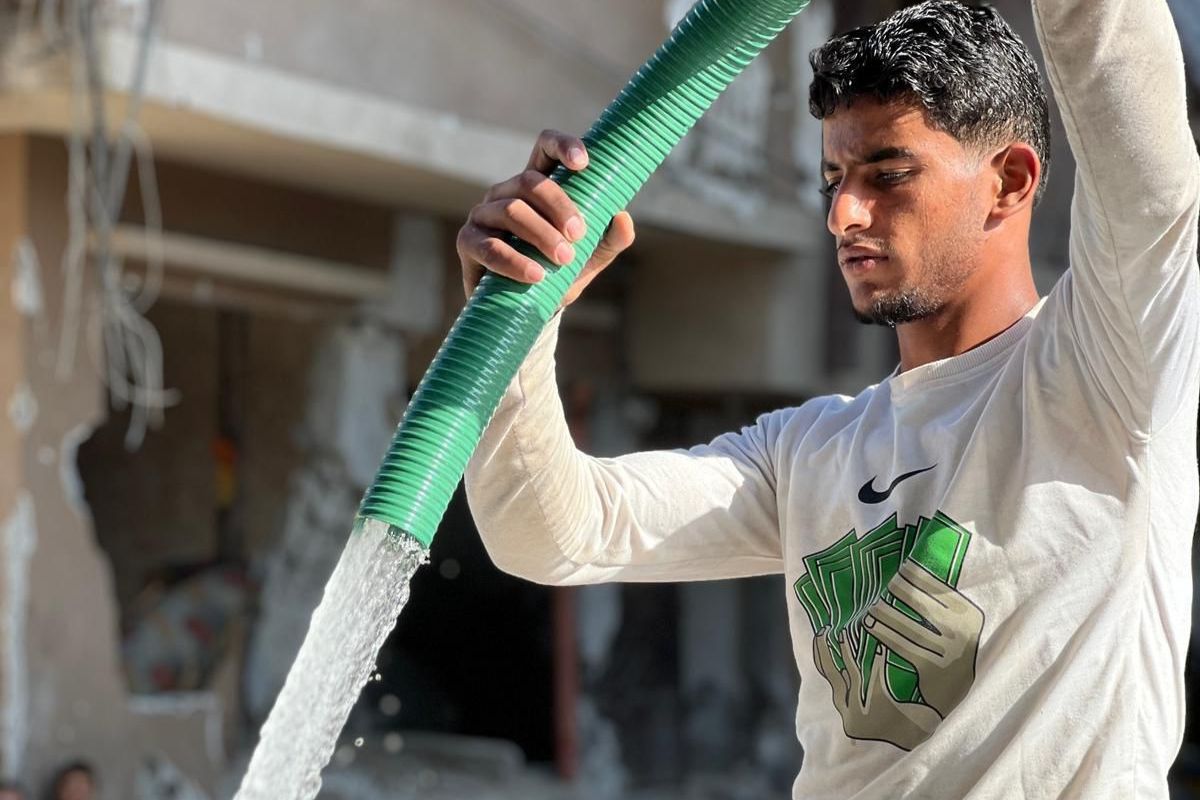
The Gaza Strip has long relied on desalination and external supplies for potable water. In the current conflict, fuel blockades and airstrikes have repeatedly rendered desalination plants inoperable. Evacuation orders, and the destruction of water treatment plants and reservoirs have further limited access to safe, clean water. Israel’s National Water Carrier network is another source, but with the mainline pipe output under control of the authorities, the taps were completely closed off at the start of the latest conflict. Pressure from the international community has led to partial restoration of the supply, but levels are nowhere near that of previous times.
The lack of potable water combined with poor sanitary conditions has led to mass outbreaks of infective diarrhoea and other intestinal diseases. In the summer of 2024, polio virus was found in sewage samples for the first time in 25 years.
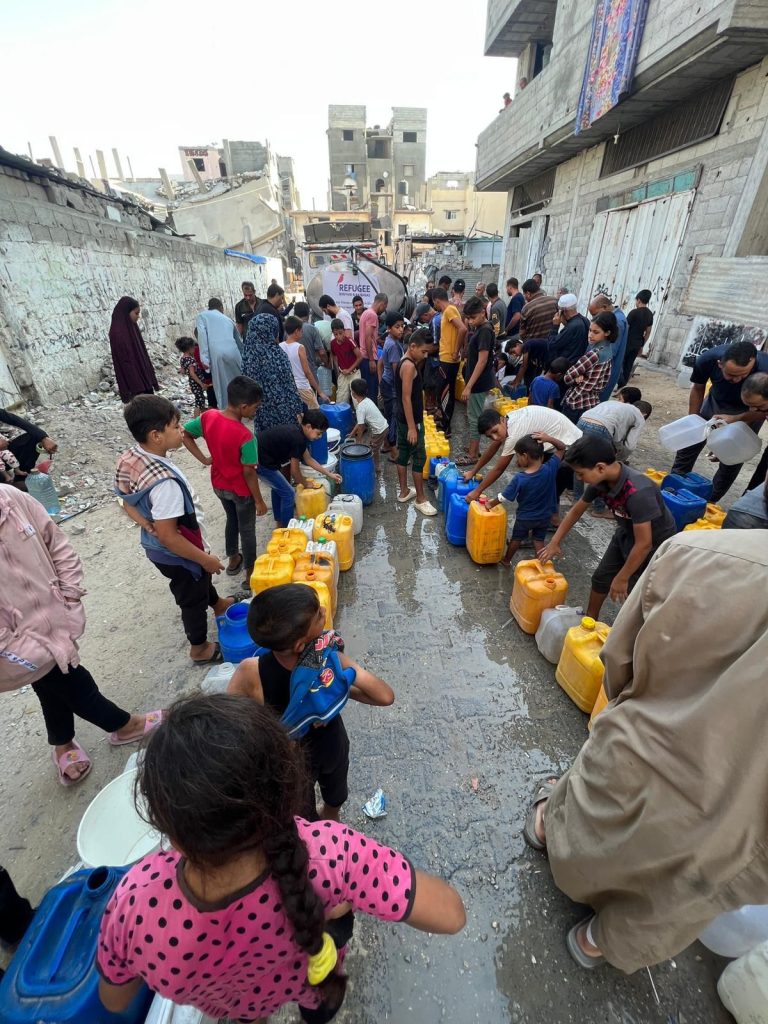
Image copyright: Refugee Biriyani & Bananas Gaza Team.
FOOD AND WATER ACCESS SINCE THE OCTOBER “CEASEFIRE”
Conflict and the implementation of a goods blockade have chronically restricted opportunities for food and water to be brought into Gaza by humanitarian aid organisations. A fragile ceasefire, called in October of this year, offered some hope. Some borders were opened and organisations and limited deliveries could recommence food, water, clothing and shelter. One focus has been on re-establishing WASH, a public health model which focuses on systems that ensure safe water, sanitation and hygiene. Repairs of desalination plants have been undertaken and some new water pipe connections made. But the situation in Gaza remains far from safe as shootings and airstrikes continue. Israel still keeps tight control of the borders. Within the first month of the ceasefire, one hundred requests for UN and partner aid deliveries were refused by the Israeli authorities. Until a lasting ceasefire is achieved and medical organisations are able to access all areas of the Gaza Strip, comprehensive assessment of the extent of malnutrition is problematic. But from data collected by UNICEF and partners in October, 9,300 children under five were diagnosed as acutely malnourished. Projections to June 2026 indicate that at least 132,000 children under five will be at risk of death from continued malnutrition—double that of estimates made earlier this year.

Image copyright: Refugee Biriyani & Bananas Gaza Team.
THE IMPACT OF RBB ACTIVITIES IN GAZA
These statistics from the last financial year highlight Refugee Biriyani & Bananas’ achievements in supporting vulnerable communities across all the international regions they cover:
- 173,219 people were helped with ongoing care or one-time assistance.
- £167,394 was spent on food supplies and £26,299 on hygiene packs.
- 18,107 food and hygiene packs were distributed. Items included cooking oil, flour, beans and pulses, fresh and tinned vegetables, milk and other dairy products, sanitary towels, body wash products and wipes.
- 355 individuals from displaced communities and conflict-affected areas engaged in RBB activities through the Community Humanitarian Leaders Programme, an initiative that provides valuable experience and community empowerment.
In Gaza specifically, RBB has been working with community partners since the beginning of the conflict. Even when the Rafah border was closed, we were able to distribute food, hygiene kits and clean drinking water by working with local teams inside Gaza.
“Through trusted community led coordination, we mobilised urgently needed aid in response to the devastating humanitarian emergency. We reached tens of thousands of people with water and food—demonstrating that solidarity can save lives.”
Amber Bauer
Chair of Trustees, RBB
Since October 2023, £283,544 has been spent on food, water and hygiene aid for Gaza. A large-scale water distribution operation involved the purchase of high-quality clean water from a local desalination plant in Khan Younis. Seventy-six trucks then delivered 380,000 litres to 120,000 people. Food and water deliveries have continued throughout 2025. Examples include the distribution of 2,600 25kg bags of flour in Gaza to 2,600 families, and sweets and treats given to children by our volunteer in the north.
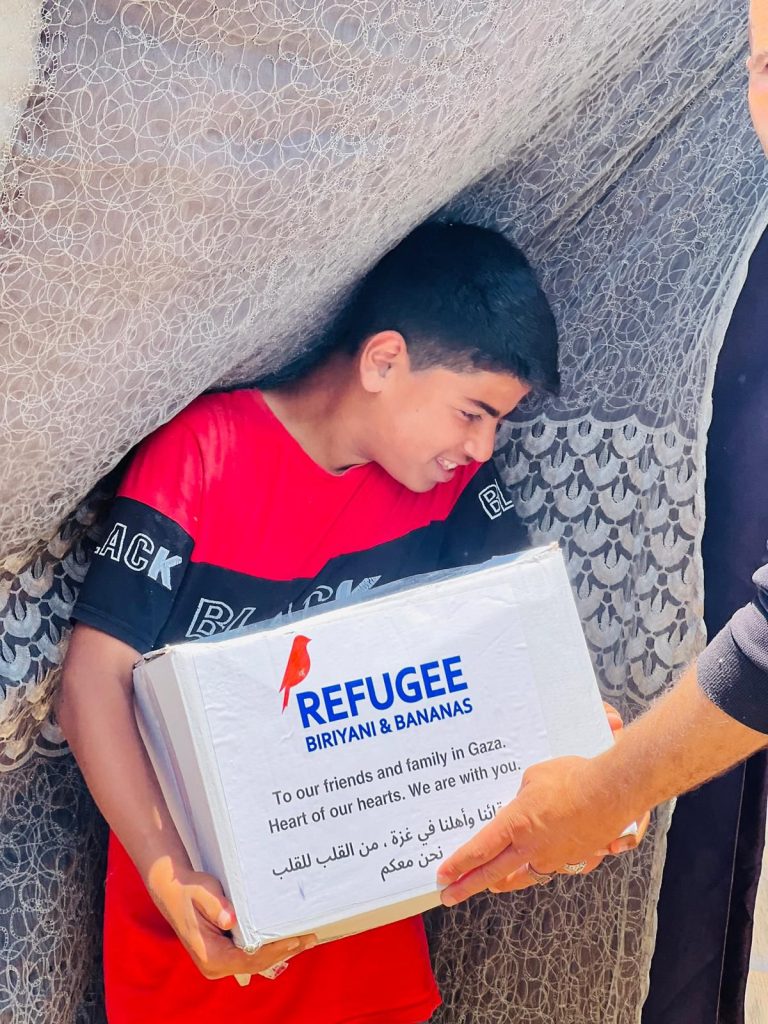
Image copyright: Refugee Biriyani & Bananas Gaza Team.
WHY RBB NEEDS YOUR HELP
While RBB works tirelessly in Gaza, the demand for food and water continues. Winter is now an additional struggle for the people of Gaza, with heavy rains and the cold significantly affecting living conditions.
The generosity of donors is an essential part of sustaining RBB’s mission. We have been supported by organisations worldwide, from as far as Australia (Operation Hope), Edinburgh (Edinburgh Direct Aid) and Spain (Red SOS Refugiados). We are also very grateful for the incredible efforts made by our individual donors and groups. RBB invites all our supporters, friends and extended community to continue to be part of our journey, whether by volunteering, donating, or organising a fund-raising event. Every action counts.Make a real difference to the lives of the people of Gaza this winter by donating to Refugee Biriyani & Bananas.